
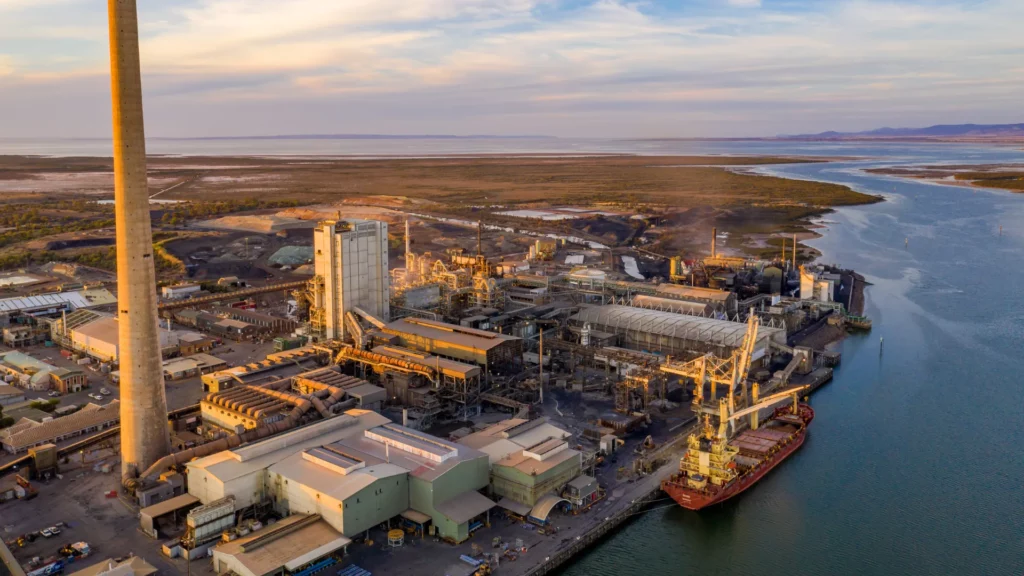
Earlier this year, Nyrstar produced a test batch of antimony, indicating its search for new markets.
Nyrstar NV announced it will receive A$135 million ($87 million) from the Australian Government to keep the Port Pirie lead smelter and Hobart zinc works operational. The funding will help them find ways to expand these sites to build critical mineral supply chains beyond China.
The Australian federal Government, along with the South Australian and Tasmanian state governments, will provide this transition support to Trafigura Group’s Nyrstar Australia. The investment will help the smelters expand and research ways to produce critical metals such as antimony. It is a silvery-white, brittle metalloid often found naturally in the Earth’s crust as the mineral stibnite.
Antimony is an alloy used to harden other metals in batteries and ammunition. It is essential for the production of semiconductors used in electronics and defence applications. It is also used in flame-retardant materials.
The funding comes after both smelters faced significant losses due to high operating costs and competition from China. Earlier this year, Nyrstar produced a test batch of antimony, indicating its search for new markets.
Matt Howell, the head of the Australian arm, stated that the smelters were losing millions of dollars every month due to a collapse in fees. However, the company also plays a key role in Trafigura’s success in the metal trading industry.
Nyrstar Global Chief Executive Officer Guido Janssen stated that the support shows the strategic importance of Australian operations for maintaining sovereign capacity and delivering products globally in the face of challenging market conditions.
The funding was a test of how far the Australian Government would go to ensure the capacity to smelt within the country. Port Pirie and Hobart hubs are such facilities that have been in operation for almost a century.
There are still questions about whether one-time funding would be enough, especially when other smelting plants, such as Rio Tinto Group’s Tomago aluminum project in New South Wales, are also seeking help from the Government.
Suresh Palanisamy, a professor of advanced manufacturing at Swinburne University, stated that it would not be sufficient to support a single smelter or an individual sector, such as the smelting industry. They would need a comprehensive strategy that takes into account the entire supply chain.
Amid these uncertainties, it is worth noting that over the past year, China has significantly increased its dominance in the world’s processing of many critical minerals. Now, it has placed restrictions on the export of antimony and rare earth minerals. As a result, it caused problems in the supply chain for industries such as automotive and defense, highlighting the geopolitical risks of relying too heavily on Chinese refining.
Therefore, the United States government and other Western administrations made it a high priority to find and strengthen an alternate supply chain.
Peter Malinauskas, the Premier of South Australia, gave a warning that China would control the manufacturing of the world’s smelting if the West did not step in and make its mark. He mentioned that it was an intolerable risk, given the current geostrategic climate that the world is in.
Tim Ayres, Australia’s Minister of Industry and Innovation, stated that Port Pirie would produce 15,000 metric tons of antimony.
Meanwhile, other struggling processing companies ask for help from government authorities after Nyrstar’s bailout.
An intergovernmental organization (IGO) has announced that it is assessing the future of its lithium hydroxide factory, which is currently running at a loss and is run by its joint venture partner Tianqi Lithium, on the outskirts of Perth.
Glencore has requested that the Government give support for its Mount Isa copper smelter in Queensland. Meanwhile, Rio Tinto has often warned of a tough future for its Tomago aluminum smelter in New South Wales, the state’s largest energy consumer, due to the high cost of power.