
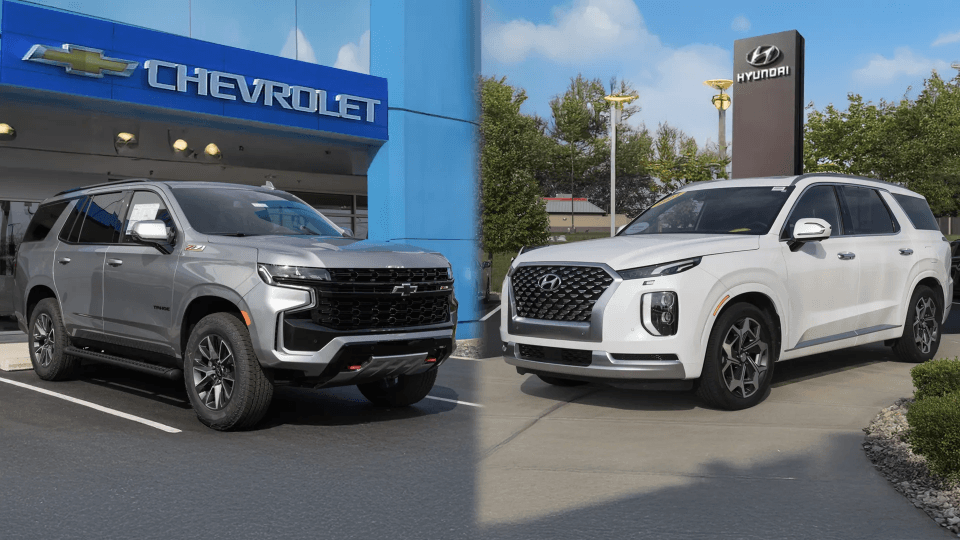
The partnership will help GM and Hyundai to fight the growing competition posed by Chinese electric vehicle manufacturers in Latin America.
General Motors and Hyundai Motor announced on Wednesday that they will collaborate to develop five cars as they seek to reduce expenses amid increasing competition from agile Chinese companies. The collaboration aims to combine their expertise and resources, potentially reducing the production costs and accelerating innovation; however, some experts have expressed doubt about whether the plan will be successful.
General Motors (GM) is leading the future of transportation by using advanced technology to produce safer, smarter, and more environmentally friendly cars. It offers a portfolio of innovative gas cars and a wide range of EVs as the world is moving towards an all-electric future.
Hyundai was founded in 1967 and has since grown to be present in over 200 countries, addressing real-world mobility challenges worldwide. To promote a sustainable future, the company will continue to put efforts into providing zero-emission cars through industry-leading hydrogen fuel cell and EV technology.
The four vehicles they plan to launch in Central and South America in 2028 are a compact SUV/vehicle/ pickup, and a pickup. It will accommodate both internal combustion and hybrid powertrains.
The partnership will help GM and Hyundai to fight the growing competition posed by Chinese electric vehicle manufacturers in Latin America. However, some have raised concerns about whether it would achieve a meaningful connection.
An Hyung-jin, chief investment officer at Seoul-based hedge fund Billionfold Asset Management, stated that even if they manage to sell new models in South America, it would be challenging to beat Chinese competitors who already have the crown in the electric vehicle industry with their low prices.
He added that Hyundai might gain insights from GM about building pickup trucks, but it will take time for them to see a profit.
The two carmakers will co-create an electric commercial van for the US market, which is expected to hit the market by 2028.
This partnership can be a win-win situation for both car makers. As Teddi Kim, head of auto research firm Mirae-Mobility Research & Services, stated, GM can gain knowledge about hybrid technology from Hyundai, and in return, it can leverage its association with GM in trade discussions with the US.
Last week, the United States and South Korea finalized a trade deal that includes 15% tariffs on US imports from South Korea, which covers cars.
But Hyundai and another South Korean automaker, Kia, want the tariffs to be cut swiftly to have a
fair shake with Japanese and European competitors.
Hyundai Motors’ stock increased by 0.7%, compared to a 0.5% gain in the wider market. The deal is among several recent collaborations between South Korean and US companies, following Samsung Electronics’ chip deal with Tesla and Apple, as well as LG Energy Solution’s battery partnership with Tesla.
This deal is the South Korean company’s first significant coloration in vehicle development.
GM has been discontinuing many projects with Japan’s Honda over the past ten years. In 2023, the companies abandoned a $5 billion project to jointly develop affordable EVs.
In other news, the Detroit-based automaker plans to invest in building a $888 million New York propulsion plant to produce the next-generation V8, which will be used in full-size trucks and SUVs and is expected to be fuel-efficient.
China is giving a tough fight, as Chinese carmakers have launched many high-tech, cost-effective models, putting pressure on established competitors like GM to reduce costs and optimize their manufacturing process. To address these challenges, many companies, similar to Hyundai and GM, have explored partnerships to share development costs, particularly for battery-powered models.
With the US imposing tariffs, the pressure to cut costs has intensified, as it has added billions of dollars in extra costs for car manufacturers worldwide.