
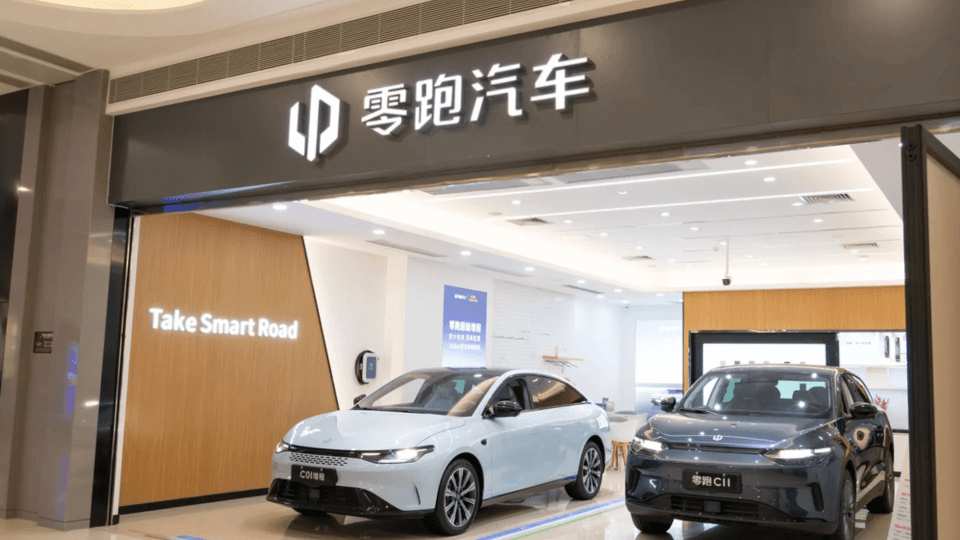
The company must scale up to one million units to reach the heights of its established Chinese EV peers.
Zhejiang Leapmotor Technology was once a minor player in the Chinese EV industry, but it has now become a big player, surpassing its competitors in both sales and stock performance, and analysts say there is more to come.
The carmaker shares surged more than 200% on the Hong Kong stock exchange, increasing twofold since January, outperforming established peers like XPeng Inc. and Xiaomi. The company increased its sales target from 290,000 to 500,000 units.
The company was founded by Zhu and co-founder Fu Liquan, who previously founded security camera manufacturer Dahua Technology. The carmaker was an underdog, with sales smaller than those of its big rivals, such as BYD.
The company was founded 10 years ago and has attracted investors by outmatching its rivals on pricing, thanks to its significant in-house production of components. A big credit goes to its co-founder, Zhu Jiangming, whose background in electronics and software contributed to its R&D. The focus for the brand was to become a more cost-effective version of Li Auto, known for its mid-range and premium SUVs.
For context, Leapmotor’s C11 SUV, launched in late 2020, has a starting price of just 148,800 yuan; however, the cheapest car from Li Auto, the L6 SUV, starts at 249,800 yuan.
The company is offering its vehicles at accessible prices, thanks to its 70% vertical integration, remarks Xiao Feng, co-head of China Industrial Research at CLSA Hong Kong. He adds that he sees growth potential in the company due to its strong product lineup and outstanding capital efficiency.
The secret to the company is that it creates and produces all its parts, apart from batteries, which helps it reduce its costs, said Rosalie Chen, an analyst at global research firm Third Bridge. This type of vertical integration gives it the financial edge over its rivals, who depend heavily on outside suppliers.
Its shares closed at HK$65.40 ($8.36) on Friday, increasing from last year’s low of HK$19.54 recorded in August. Analysts predicted that the shares will increase to HK$74.89 within the next year.
The company’s focus on mass market appeal has worked in its favour in recent times as China’s slowing economy has made consumers more cost-conscious. This trend has helped Leapmotor to achieve its monthly sales target of exceeding 500,000 cars in July for the first time.
Despite its current wins, it is not guaranteed that it can sustain this growth trajectory.
To reach the heights of its established Chinese EV peers, it must prove its ability to scale across various segments in the Chinese EV market and reach one million units, which many niche-focused EV makers struggle to achieve, said Gary Tan, a fund manager at Allspring Global Investments in Singapore.
Another challenge is ensuring long-term profitability. The company is on track to make progress, with analysts predicting a profit of 558 million yuan for 2025. They will come with the first half results progress later.
One hope for future growth is its joint venture with European automaker Stellantis NV, announced in 2023. As part of this partnership, Stellantis, known for making Chrysler, Fiat, Jeep, and Peugeot cars, agreed to produce and sell some of Leapmotor’s models outside China.
This strategy falls outside of its brand of producing in-house, which helped it secure a share of the domestic market, and differs from other Chinese manufacturers like BYD, which is building factories in Hungary and Turkey. In theory, it will help the company to develop an international presence quickly. Last year, the company exported 13,726 units, which is 5% of its sales.
Allspring Global’s Tan said that export momentum and capitalizing on software monetization will help the company scale from a domestic to a global EV brand.