

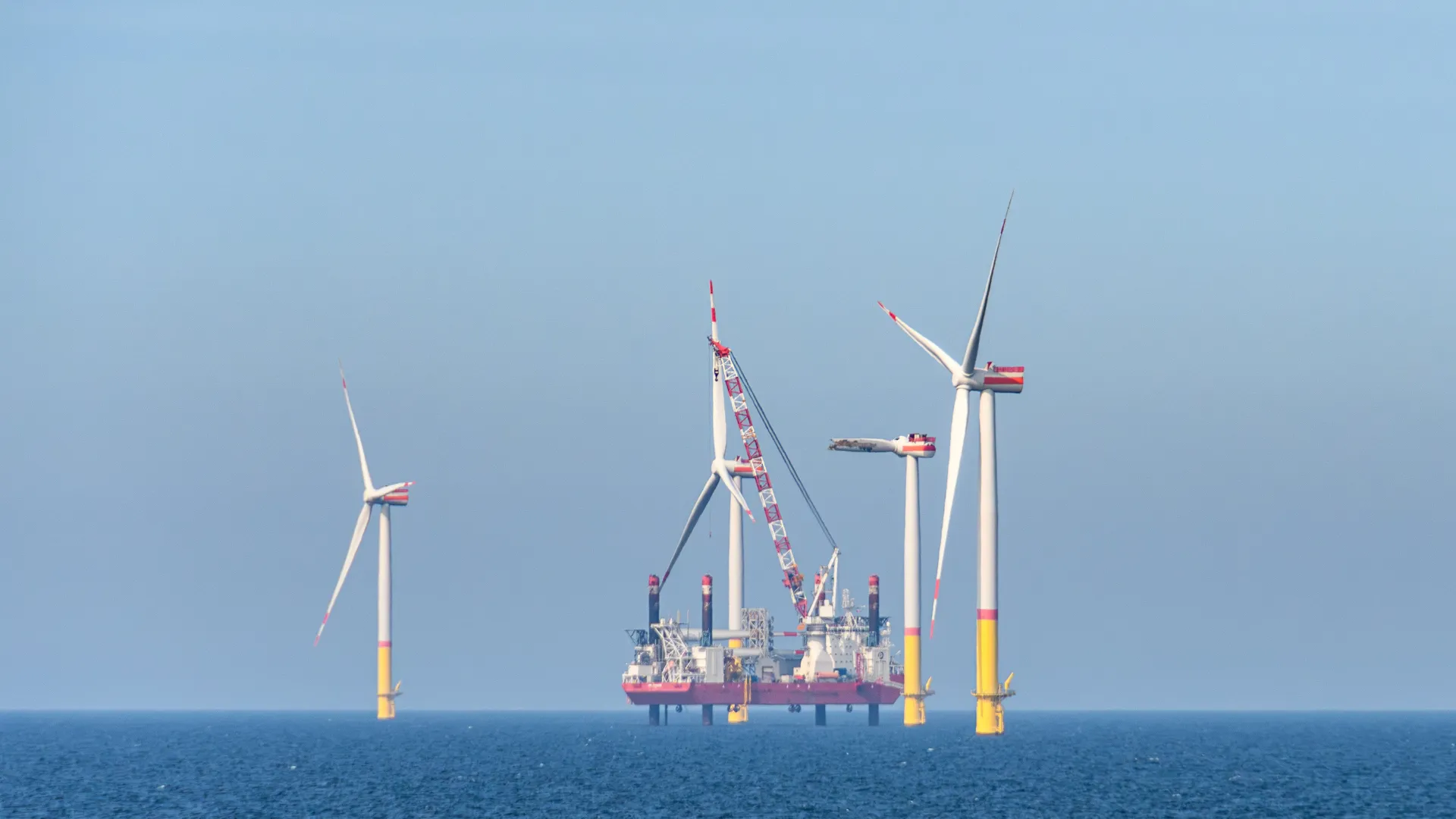
The module was lifted and set up by Heerema Marine Contractors’ crane vessel Sleipnir, which is the world’s biggest crane and had previously installed offshore jacket foundations required for this project over the summer.
ScottishPower Renewables has installed its first high voltage direct current (HVDC) offshore converter station at East Anglia 3 wind farm near Suffolk, England. This converter station has a capacity of 1,400MW and is a seven-storey structure, weighing 10,700 tonnes.
The module, which is 70 m long, 34 m wide, and 48 m high, is the largest one constructed by the company’s parent group, Iberdrola Group, thus far. ScottishPower said that the platform will convert electricity from high-voltage alternating current (AC) to direct current, before it is transmitted to the shore from the 95-turbine wind farm.
This project cost 4 billion euros and is ScottishPower’s first experiment with HVDC technology, which is the most efficient way electricity can be transported across long distances. The module was lifted and set up by Heerema Marine Contractors’ crane vessel Sleipnir, which is the world’s biggest crane and had previously installed offshore jacket foundations required for this project over the summer.
Siemens Energy has provided the power transmission technology required inside the module, and its initial fabrication was completed in Romania last year, following which it was sent to Aker Solutions’ fabrication yard in Norway for completion. The 1.4 GW wind farm is set to begin operations by the end of 2026 and will be the world’s largest, providing clean energy to power over 1 million homes, or its equivalent.
According to Charlie Jordan, CEO of ScottishPower Renewables, the East Anglia 3 project has hit a new milestone with the installation of this HVDC converter station. Darren Davidson, Vice President, Siemens Energy, UK&I, said that HVDC’s power transmission capabilities reduce losses and support the UK’s grid stability. The completion of this project is a remarkable feat for renewable energy companies, as it signifies a breakthrough in complex engineering and hastens the adoption of clean energy.
While the UK’s Labour government says it is determined to increase the adoption of clean energy and commit to its fight against climate change, it recently announced a reduced budget for offshore wind in its forthcoming auction. Officials, however, maintain that this was done to increase investments in the renewable energy sector.
Risk analysts were quick to point out that this move would lead to more challenges for the UK to meet its clean energy targets. In an upcoming auction for offshore wind projects in the country, there will be a considerable reduction in the budget for traditional, fixed-bottom installations. While 1.1 billion pounds were allocated last year, 2025’s budget has been set to 900 million pounds.
This drop is likely to impede the development of new offshore wind farms, compromising the UK’s targeted pace to achieve renewable energy transitions. The drop raised questions about whether government priorities would change or whether plans for investments in renewable energy might be reassessed, especially in light of fixed offshore wind technology, which is more established.
Industry experts and market observers are awaiting more information about the reasons behind this budget drop, as well as any possible long-term impacts on investor confidence and project feasibility. The development of floating wind technologies has been given an extra £180 million. Unlike last year, it has a fixed budget this year and will not have to contend with competing new technologies like geothermal and tidal.
The UK is committed to decarbonising its energy sector by 2030. The significant increase in its offshore wind power capacity is a key component of this ambitious goal. There are currently about 15 gigawatts (GW) of offshore wind power in the UK. The government plans to dramatically increase this to between 43 and 50 GW by the end of the decade. This significant rise demonstrates a strong commitment to renewable energy sources as the main way to ensure a sustainable energy future and move away from fossil fuels.