
Lockheed Martin Secures 10-Year $78 Billion Deal With US Government
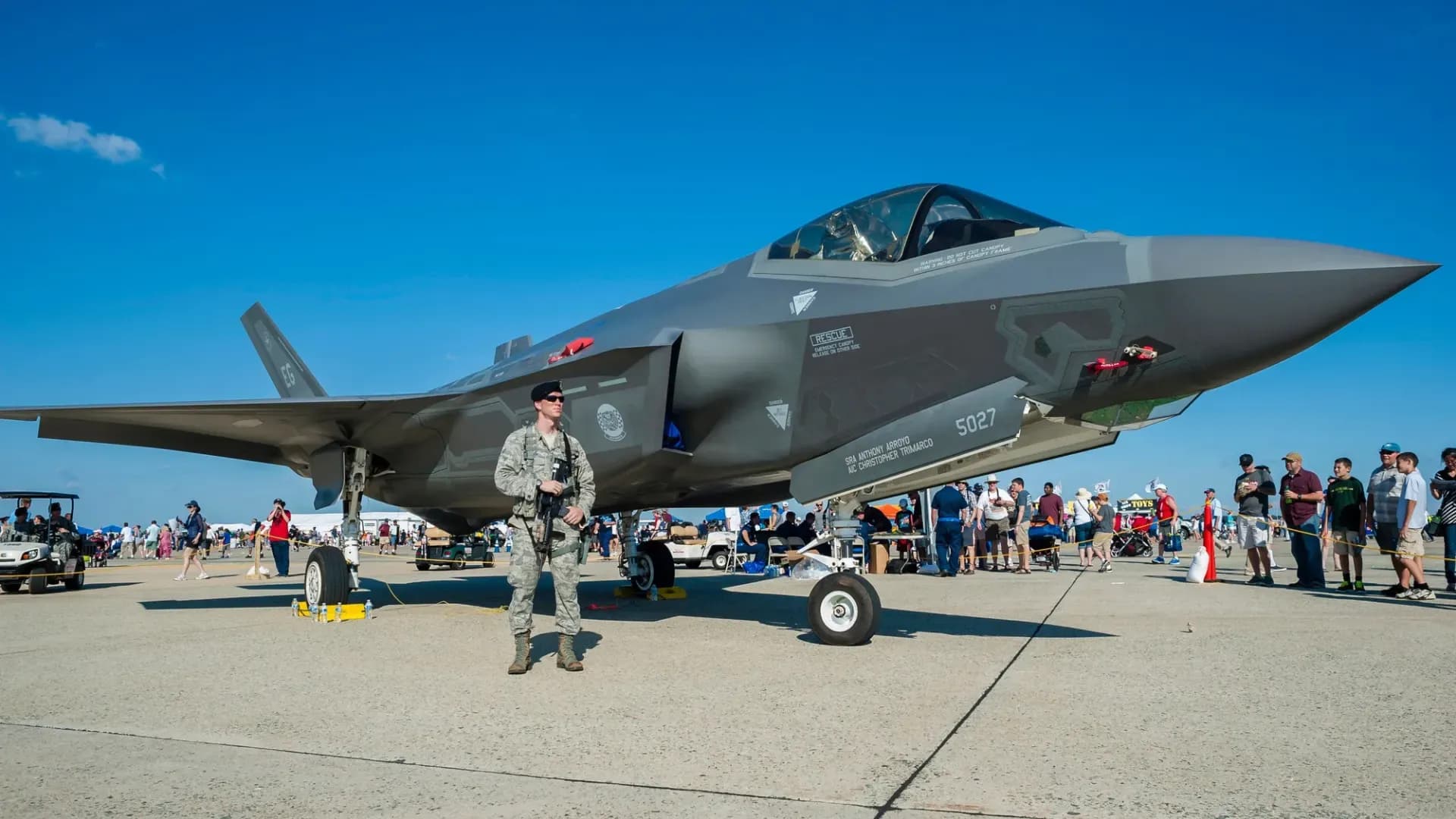

Lockheed Martin has signed a deal to sell around 850 stealthy F-35 Lightning II fighter jets to the Pentagon over the next 10 years for $78 billion. The news helped Lockheed’s shares, which surged 10%, the biggest percentage gain in three months. The company also raised its 2026 free cash flow forecast to about $7.8-8 billion, from $7-$7.2 billion earlier.
Lockheed’s decision to raise its annual sales and profit forecasts, placing it higher than analysts’ estimates, is tied to escalating geopolitical conflicts boosting demand for its systems. Roughly 40% of the US defence contractor’s quarterly revenue comes from its fighter jet sales, which are considered the most advanced in the world.
Fighter jet manufacturing is at the heart of Lockheed’s aeronautics division, and they incorporate stealth technology, which prevents enemies from detecting the jets. As per the agreement, the company will attempt to produce at least 156 aircraft for the US and international clients, and it will also self-finance about $7 billion in initiatives that support the F-35 program.
According to OJ Sanchez, President of Lockheed Martin's aeronautics segment, this investment will help the current production line as well as the supply base, the tooling, and the workforce repair lines. As the F-35 fleet expands, repair and maintenance requirements are also rising. This is putting pressure on F-35’s manufacturing and repair capacity.
The investment will be partially diverted towards funding new repair lines at the original equipment manufacturers. This is because smaller suppliers lack dedicated repair lines and have to use the same equipment and workers for repair work that they use for manufacturing new parts.
While the agreement does not include a sales order, Lockheed views it as a prearranged long-term contract. The deal must secure approval from both houses of Congress. The aircraft manufacturer’s Q3 sales rose 11% to $20.71 billion, with a 24% growth in its missile unit on higher PAC-3 and THAAD production. The aeronautics revenue from the F-35 and C-130 programs also recorded a 13% increase. Lockheed narrowly beat analysts’ quarterly sales estimates of $20.51 billion.
The least expensive version of the F-35 jet costs roughly $92 million, therefore placing the 10-year deal at $78.2 billion. The Marines' F-35B short take-off and landing version of the jet and the Navy's F-35C cost $121 million and $110 million, respectively. While the contract’s mix of jets is yet to be confirmed, prices are subject to rising inflation and labour costs.
Lockheed plans to increase fourth-quarter capital spending via investments to expand its munitions production capacity. Q3 share price was also above the $7.43 per share forecast, coming in at $7.97 apiece. It also estimates 2026 sales of about $80-$82 billion, up from its prior forecast of $79.75 billion to $81.75 billion.
Lockheed was among the many aerospace and military contractors to raise 2026 profit forecasts, as improved demand from military programs has sent profits and share prices to new highs. Industry rival RTX raised its sales forecast range to between $97 billion and $97.5 billion, from $95 billion to $96 billion, and its adjusted earnings to $7.65 to $7.75 apiece, up from $7.10 to $7.25 per share. GE Aerospace also increased its 2026 adjusted earnings to $8.00 to $8.10 per share from its previous forecast of $7.65 to $7.85 and above analyst expectations of $7.92.
Along with lifting its annual earnings-per-share forecast from the $29.95 to $30.65 to $30.35 and $30.75 range, Lockheed’s backlog also surged 27% sequentially to a record $292 billion. This rise was linked to a $52.5 billion multiyear award for PAC-3 Missile Segment Enhancement interceptors, which are used extensively by the US and its allies against Iran in the ongoing conflict.