
Bank Of America’s Shares Drop 8% After Q3 Misses And $1.2 Billion Penalty
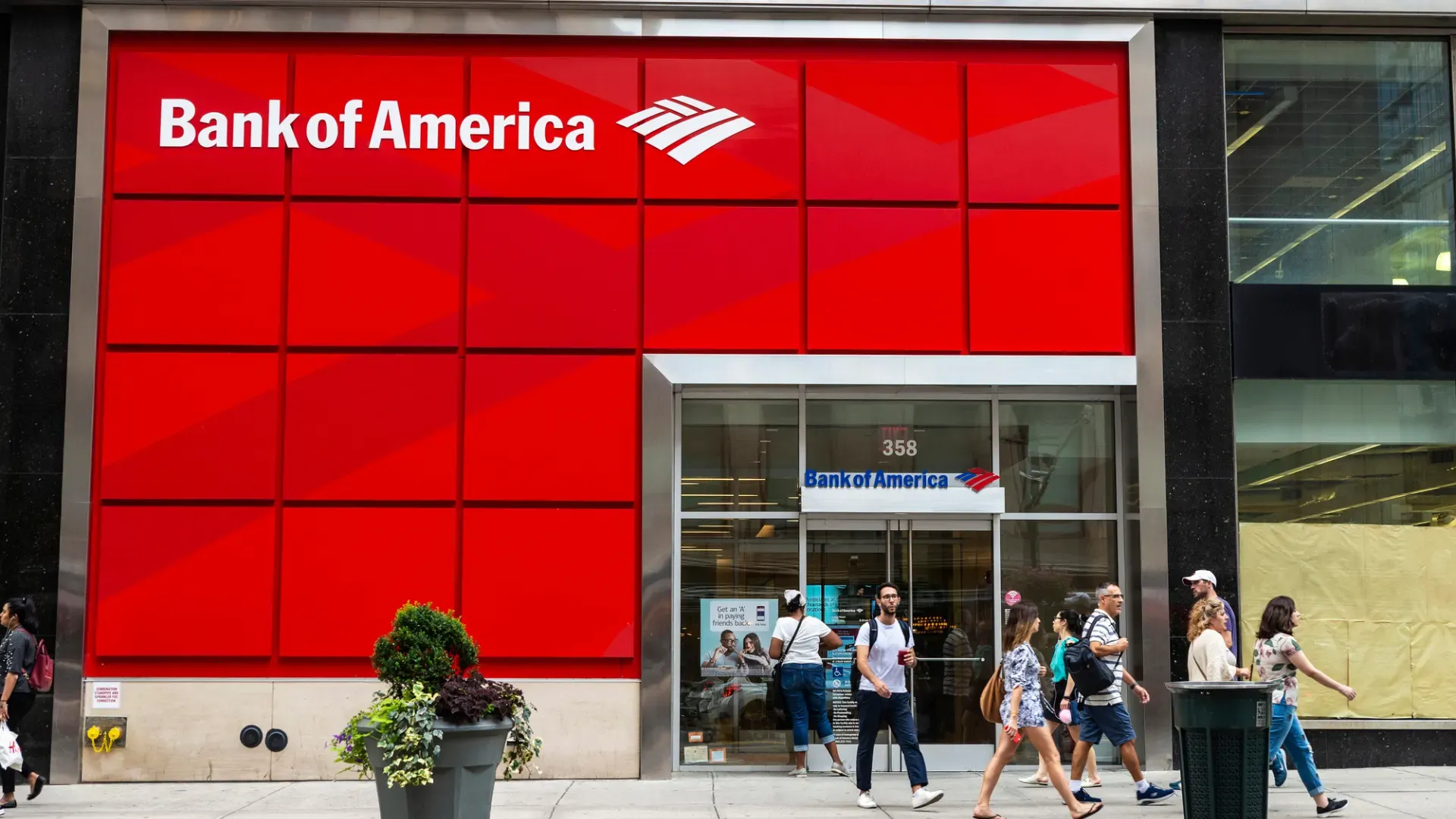

The Bank of America (BofA) missed Q3 profit estimates due to weak trading businesses. It disclosed that it was charged a $1.2 billion regulatory penalty for failing to detect potential money-laundering activity. This revelation caused the bank’s shares to drop over 8%, hitting their lowest price since May.
The quarter ended September 30 saw BofA’s sales and trading revenue fall 5% to $5.1 billion owing to weakness in FICC, whose negative impact could not offset the record quarterly equities trading. Last month, the second-largest lender in the US had anticipated relatively flat quarterly sales and trading revenue compared to 2025.
BofA’s bond portfolio, which includes mortgage-backed securities and US Treasury and government-agency bonds, also had unrealised losses. Bond yields rose higher in Q3, and BofA’s bonds went up from $85 billion in the second quarter to $109 billion in the third quarter. A majority of these securities are the held-to-maturity type, and the Bank does not intend to sell them.
According to Chief Financial Officer Alastair Borthwick, dwindling client activity and changing market conditions, including a major shift in interest rates, affected the Bank’s leading FICC businesses like credit mortgages and municipals.
BofA was not the only moneylender posting missed estimates. Rivals like Goldman Sachs, JP Morgan and Wells Fargo also recorded weaker fixed income, currency and commodities revenue. JP Morgan’s Q3 investment banking fees fell from 14% in the second quarter to 8% in the next, and fixed income trading revenue also fell 4%.
Wells Fargo also joined the trend, with net interest income rising 5% to $12.52 billion, short of expectations of $12.63 billion. Revenue was $21.87 billion, missing the $22.31 billion forecast. While Q3 performance did not live up to analysts’ expectations, CFO Mike Santomassimo is positive that the last quarter of 2026 will see net interest income grow, helped by loan and deposit growth and higher interest rates.
Goldman Sachs was the only prominent US bank which posted positive performance, beating profit estimates. However, fixed income, currency and commodities revenue was lower than anticipated, in line with fellow Wall Street giants. With a strong quarter for equities, driven by the Federal Reserve's interest-rate hike, rising oil prices and chip stocks being sold off in large numbers, Goldman’s equities business posted a 72% jump in quarterly revenue to $6.44 billion.
The regulatory penalty was yet another reason for BofA’s shares to tumble. This $1.2 billion fine has been described as the third-largest penalty in the history of the Treasury Department. The Bank has been accused of not reporting over $5 billion in suspicious activity to the government, of which $1 billion posed national security-related and other priority illicit finance risks.
Treasury Secretary Scott Bessent said that financial institutions are trusted to uphold economic and national security. Therefore, for a leading bank to falter from its anti-money laundering and sanctions commitments throws the entire country’s financial system at risk.
The Treasury has placed the BofA under a consent order, which is a major regulatory penalty. As per the consent order, the Bank must now work with a third party to identify and report suspicious transactions that went undetected. BofA has defended itself by saying it has been working with regulators for a considerable period of time and that it had already taken on a very large number of people to amp up its efforts to tackle money laundering.
BofA earned $1.08 per share, short of the $1.10 per share forecast, apart from the $1.2 billion regulatory settlement charge. Wall Street analysts believe that this penalty could lead to negative sentiment from investors and raise concerns about expenses and the duration of the order.
However, despite these misgivings from industry observers, BofA expects interest income to improve in the next quarter, and projects net interest income for the full year to 8% or more in 2027.